

On November 7, doctors from the Department of General Surgery at Huu Nghi Hospital successfully performed a nearly 5-hour surgery to save Mr. Duong Van B. (81 years old, Hoang Mai, Hanoi), who simultaneously suffered from a nearly 9-cm infrarenal abdominal aortic aneurysm at risk of rupture and a severely infiltrative colorectal tumor.
Mr. B. had a medical history of hypertension, diabetes, and an abdominal aortic aneurysm for which stent graft placement had been indicated but had not yet been performed. Before admission, the patient experienced severe pain around the umbilical and lower abdominal regions. Examination revealed a large mass occupying nearly half of the right side of the abdomen and pulsating with the heartbeat.

The medical team is performing surgery on the patient.
The CT scan showed an infrarenal abdominal aortic aneurysm extending to both iliac arteries, with a diameter of nearly 9 cm and signs of rupture. At the same time, the sigmoid colon and rectum showed wall thickening, infiltration, and dense adhesion to the iliac vessels. The doctors diagnosed a large abdominal aortic aneurysm at risk of rupture, accompanied by suspected sigmoid colon cancer.
Given the critical condition, an interdisciplinary consultation involving Interventional Cardiology, General Surgery, and Anesthesiology and Critical Care agreed to perform emergency surgery.
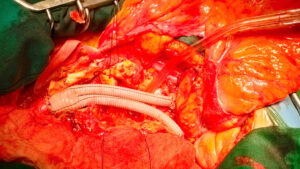
During the nearly 5-hour operation, the surgical team replaced the affected segments of the abdominal aorta and both iliac arteries with artificial grafts, followed by resection of the colorectal segment containing the tumor and immediate anastomosis. This was considered a challenging procedure because it required simultaneous management of a clean procedure (vascular surgery) and a contaminated procedure (colorectal surgery), which are normally not performed at the same time.
Dr. Hoang Viet Dung, Head of the Department of General Surgery and the surgeon who directly performed the operation, said that abdominal aortic aneurysm is a complex condition involving multiple branches supplying the internal organs and carries a high risk of death if rupture occurs. The simultaneous occurrence of abdominal aortic aneurysm and colorectal cancer is very rare, occurring in only 0.2–2% of cases according to the medical literature.
“Normally, two separate surgeries are required, with the aneurysm treated first and colon surgery performed afterward. However, in this case, the tumor was adherent to the aortoiliac surgical area, requiring us to perform both procedures in a single operation,” Dr. Dung said. “This was a major challenge because vascular surgery requires absolute sterility, while colorectal surgery is a contaminated procedure.”
Following surgery, the patient remained hemodynamically stable, passed gas after three days, and was able to walk and eat normally after 11 days. On the 14th day, he was discharged with good graft patency, no lower-limb ischemia, and normal bowel movements. The pathological examination confirmed colorectal carcinoma.
According to Dr. Dung, abdominal aortic aneurysm commonly occurs in older adults, particularly those who smoke or have hypertension, atherosclerosis, or diabetes. Colorectal cancer, meanwhile, is common among middle-aged adults and is increasingly affecting younger people.